Biographical details
Bishop Peter Brignall, is the third Bishop of Wrexham, succeeding the Rt Rev Edwin Regan,
Bishop emeritus of Wrexham.
Born in Whetstone, London, he was ordained as a priest by the Rt Rev Langton Fox, Bishop of Menevia in 1978 and was incardinated as a priest to the diocese of Wrexham on the 12th February 1987.
Bishop Peter was Cathedral Dean of St. Mary’s, Wrexham from 1999 and Vicar General of the Diocese since 2003.
Appointment as Bishop of Wrexham
Monsignor Brignall was appointed Bishop of the Diocese of Wrexham by the Holy See on the
27th June 2012.
At the time of the announcement from the Holy See, Bishop Peter said:
"after having overcome the initial astonishment of the Holy Father’s expression of confidence in me, am humbled and honoured to accept this appointment and to be able again to commit my life to the service of the Catholic Church in North Wales, a Church that now 35 years ago I chose and offered to work in and for on leaving London.”
On the 12th of September 2012, Bishop Peter was consecrated by the Right Reverend Edwin Regan, Bishop emeritus of Wrexham to the Episcopate at St Mary’s Cathedral, Wrexham.
Bishop Peter Brignall, is the third Bishop of Wrexham, succeeding the Rt Rev Edwin Regan,
Bishop emeritus of Wrexham.
Born in Whetstone, London, he was ordained as a priest by the Rt Rev Langton Fox, Bishop of Menevia in 1978 and was incardinated as a priest to the diocese of Wrexham on the 12th February 1987.
Bishop Peter was Cathedral Dean of St. Mary’s, Wrexham from 1999 and Vicar General of the Diocese since 2003.
Appointment as Bishop of Wrexham
Monsignor Brignall was appointed Bishop of the Diocese of Wrexham by the Holy See on the
27th June 2012.
At the time of the announcement from the Holy See, Bishop Peter said:
"after having overcome the initial astonishment of the Holy Father’s expression of confidence in me, am humbled and honoured to accept this appointment and to be able again to commit my life to the service of the Catholic Church in North Wales, a Church that now 35 years ago I chose and offered to work in and for on leaving London.”
On the 12th of September 2012, Bishop Peter was consecrated by the Right Reverend Edwin Regan, Bishop emeritus of Wrexham to the Episcopate at St Mary’s Cathedral, Wrexham.
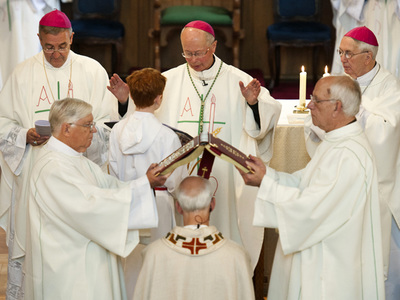
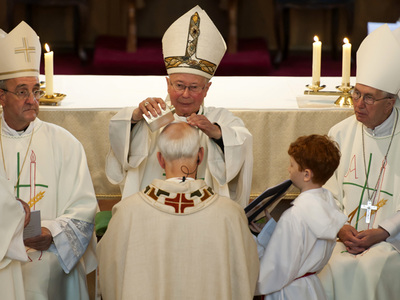


Homily preached by the Archbishop of Cardiff George Stack at the Ordination of Bishop Peter
In his homily, the Archbishop of Cardiff, Archbishop George Stack spoke of Bishop Brignall’s distinguished ministry as a "parish priest, hospital chaplain, chaplain to the deaf, university chaplain, Dean of the Cathedral and Vicar General".
He noted that they were "just some examples of his willingness and capacity to be of service wherever he is needed."
The Homily
During the retreat which precedes Episcopal ordination, the candidate becomes painfully aware of his unworthiness for the office to which he is called. He reads the scriptures, reflects on the teaching of the Church, and embraces the tradition. He realises that humanly speaking, this ministry does cannot depend on his gifts alone, but on the power and the grace of the Holy Spirit which breathes through the Body of Christ which is the Church.
During his retreat, Bishop-elect Peter may even have found himself in agreement with the words of Blessed Humbert of Roman (circa 1190-1277). Humbert was the 5th Master of the Dominican order elected in 1254. He remonstrated with his teacher St. Albert the Great who had been appointed a Bishop:
“I would rather you were dead than a Bishop…..Why ruin your reputation and that of the Order by letting yourself be taken away from poverty and preaching? However troublesome you find the brethren, do not imagine that things will be better when you have the clergy and the secular powers to deal with…Better to lie in a coffin than sit in a Bishop’s chair!”
Peter’s missionary spirit took him away, not from the Dominicans but from the Diocese of Westminster to Wrexham in 1977. Cardinal Hume allowed him to leave on condition “that he didn’t take anyone else with him”. He didn’t take me with him from Westminster at that time, but thirty five years later I too followed the call of St. David, and am now privileged with him and Bishop Tom Burns to serve God’s people here in Wales. Peter’s distinguished ministry as a parish priest, hospital chaplain, chaplain to the deaf, university chaplain, Dean of the Cathedral and Vicar General are just some examples of his willingness and capacity to be of service wherever he is needed. “Watch over the flock God has entrusted to you, not simply as a duty but gladly,…because you are eager to do it”. (1 Peter 5:2)
Before his ordination, the new Bishop is asked publicly and personally if he is willing to undertake this service for the glory of God and the salvation of God’s people. ”Are you resolved to maintain the deposit of faith? Are you resolved to build up the Church? Are you resolved to be unite to the successor of Peter? To be compassionate? To be a good shepherd and above all to pray with and for the People of God? He accepts the mandate given to every bishop to sanctify, to teach and to govern when he answers: “I am with the help of God”.
The Sacrament of Orders is conferred through the laying on of hands and prayer. The imposition of hands by all the bishops happens in silence. The human word is inarticulate. The soul opens in silence to God whose hand stretches from eternity into the world of time and embraces this man, directs and orders him for service of the whole Body which is the Church. And then the prayer of consecration. Pope Benedict reminds us “No man can make another man a priest or a bishop. It is the Lord himself who, through these sacramental signs and prayer, draws a man into His own priesthood”. Through his ministry as Bishop, Peter will make the priesthood of Christ visible in this place, at this time and for these people in the changing circumstances of the world in which we live.
The symbols of Episcopal office speak in a silent language of the presence of Christ in his Church particularly when it is gathered around the Bishop in worship. The anointing of his head with the Oil of Chrism, sealing the bond between Christ and his new apostle. “The spirit of the Lord has been given to me, for the Lord has anointed me” said the prophet Isaiah (61:1) The mitre represents a crown of holiness in life and in ministry. It is also a reminder that holiness cannot by-pass the crown of thorns, the crown of suffering in each person’s life. And the Bishops staff – a sign of direction and hope. Reaching out to those in any need whatsoever and a reminder that he himself has to be supported and upheld by the Prayer of the Church.
The Cathedral gives its name to this Cathedral. It is not just any old chair. It is the seat of teaching, listening and learning. In his role as teacher the Bishop is called to speak God’s word. The Word is not his own. No matter what their background, outlook, point of view, people are gathered around their Bishop in unity, identity and communion with God and with each other. The Cathedral is a holy place.
Bearing all that in mind, Bishop Peter’s Retreat may well have led him to reflect on the words of the 5th century Bishop, St. Augustine of Hippo. On the anniversary of his ordination Augustine preached:
When I am fearful of what I am for you
I draw strength from what I am with you.
For you, I am a Bishop.
With you, I am a Christian.
The former is an office received.
The latter is the foundation of salvation.
Help me by your prayers and obedience
To carry out these serious and varied duties.
Then I shall have the joy
Not so much of ruling you
As of being useful to your salvation.
In his homily, the Archbishop of Cardiff, Archbishop George Stack spoke of Bishop Brignall’s distinguished ministry as a "parish priest, hospital chaplain, chaplain to the deaf, university chaplain, Dean of the Cathedral and Vicar General".
He noted that they were "just some examples of his willingness and capacity to be of service wherever he is needed."
The Homily
During the retreat which precedes Episcopal ordination, the candidate becomes painfully aware of his unworthiness for the office to which he is called. He reads the scriptures, reflects on the teaching of the Church, and embraces the tradition. He realises that humanly speaking, this ministry does cannot depend on his gifts alone, but on the power and the grace of the Holy Spirit which breathes through the Body of Christ which is the Church.
During his retreat, Bishop-elect Peter may even have found himself in agreement with the words of Blessed Humbert of Roman (circa 1190-1277). Humbert was the 5th Master of the Dominican order elected in 1254. He remonstrated with his teacher St. Albert the Great who had been appointed a Bishop:
“I would rather you were dead than a Bishop…..Why ruin your reputation and that of the Order by letting yourself be taken away from poverty and preaching? However troublesome you find the brethren, do not imagine that things will be better when you have the clergy and the secular powers to deal with…Better to lie in a coffin than sit in a Bishop’s chair!”
Peter’s missionary spirit took him away, not from the Dominicans but from the Diocese of Westminster to Wrexham in 1977. Cardinal Hume allowed him to leave on condition “that he didn’t take anyone else with him”. He didn’t take me with him from Westminster at that time, but thirty five years later I too followed the call of St. David, and am now privileged with him and Bishop Tom Burns to serve God’s people here in Wales. Peter’s distinguished ministry as a parish priest, hospital chaplain, chaplain to the deaf, university chaplain, Dean of the Cathedral and Vicar General are just some examples of his willingness and capacity to be of service wherever he is needed. “Watch over the flock God has entrusted to you, not simply as a duty but gladly,…because you are eager to do it”. (1 Peter 5:2)
Before his ordination, the new Bishop is asked publicly and personally if he is willing to undertake this service for the glory of God and the salvation of God’s people. ”Are you resolved to maintain the deposit of faith? Are you resolved to build up the Church? Are you resolved to be unite to the successor of Peter? To be compassionate? To be a good shepherd and above all to pray with and for the People of God? He accepts the mandate given to every bishop to sanctify, to teach and to govern when he answers: “I am with the help of God”.
The Sacrament of Orders is conferred through the laying on of hands and prayer. The imposition of hands by all the bishops happens in silence. The human word is inarticulate. The soul opens in silence to God whose hand stretches from eternity into the world of time and embraces this man, directs and orders him for service of the whole Body which is the Church. And then the prayer of consecration. Pope Benedict reminds us “No man can make another man a priest or a bishop. It is the Lord himself who, through these sacramental signs and prayer, draws a man into His own priesthood”. Through his ministry as Bishop, Peter will make the priesthood of Christ visible in this place, at this time and for these people in the changing circumstances of the world in which we live.
The symbols of Episcopal office speak in a silent language of the presence of Christ in his Church particularly when it is gathered around the Bishop in worship. The anointing of his head with the Oil of Chrism, sealing the bond between Christ and his new apostle. “The spirit of the Lord has been given to me, for the Lord has anointed me” said the prophet Isaiah (61:1) The mitre represents a crown of holiness in life and in ministry. It is also a reminder that holiness cannot by-pass the crown of thorns, the crown of suffering in each person’s life. And the Bishops staff – a sign of direction and hope. Reaching out to those in any need whatsoever and a reminder that he himself has to be supported and upheld by the Prayer of the Church.
The Cathedral gives its name to this Cathedral. It is not just any old chair. It is the seat of teaching, listening and learning. In his role as teacher the Bishop is called to speak God’s word. The Word is not his own. No matter what their background, outlook, point of view, people are gathered around their Bishop in unity, identity and communion with God and with each other. The Cathedral is a holy place.
Bearing all that in mind, Bishop Peter’s Retreat may well have led him to reflect on the words of the 5th century Bishop, St. Augustine of Hippo. On the anniversary of his ordination Augustine preached:
When I am fearful of what I am for you
I draw strength from what I am with you.
For you, I am a Bishop.
With you, I am a Christian.
The former is an office received.
The latter is the foundation of salvation.
Help me by your prayers and obedience
To carry out these serious and varied duties.
Then I shall have the joy
Not so much of ruling you
As of being useful to your salvation.